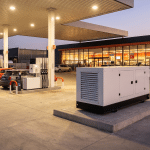
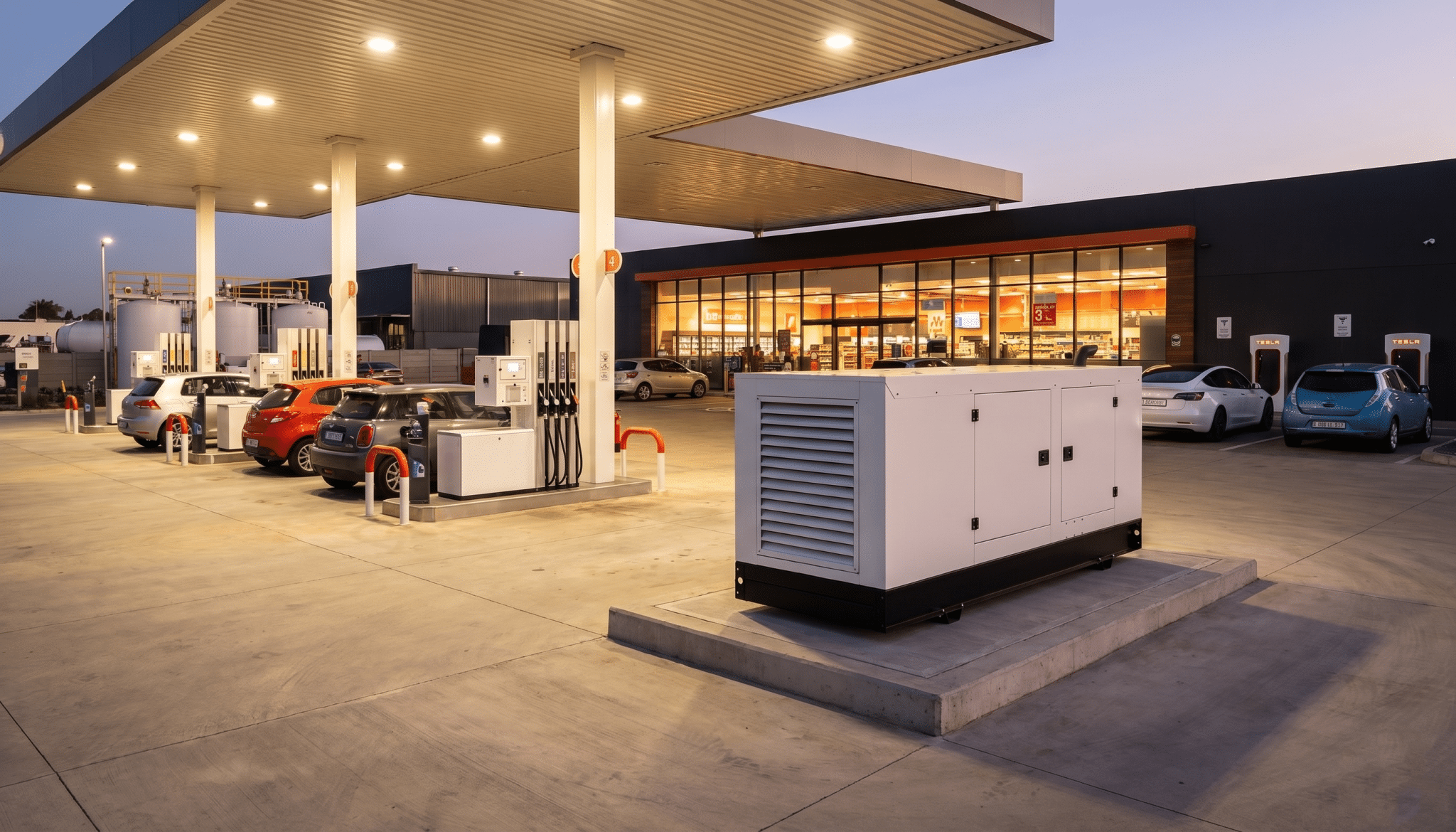
In this article we explore how changes in technology are impacting Generator Systems for Fuel Stations. The architectural profile of the South African service station has undergone a massive structural shift. Driven by shrinking fuel margins and the rapid, commercial roll-out of high-capacity Electric Vehicle (EV) fast-charging networks across major transit corridors, the modern forecourt has evolved into a highly complex, multi-load retail utility hub.
A forecourt is no longer defined as a simple cluster of low-draw fuel pumps and standard canopy lighting. Today, a single site frequently operates continuous quick-service commercial kitchens, extensive walk-in refrigeration arrays, automated car washes, and multiple high-output DC fast chargers simultaneously.
For electrical engineers and property developers, this diversification introduces a severe operational hazard. When the local grid drops or experiences a localized phase failure, the onsite standby generator plant can no longer act as a passive backup box. It must function as an active, isolated microgrid capable of balancing linear, highly inductive, and severely non-linear digital loads at the exact same microsecond.
1. The Physics of EV Fast Charging and Non-Linear Loads
The primary engineering challenge of a modern forecourt layout centers on how an engine-alternator assembly reacts to an EV DC fast charger. Electric vehicle chargers are fundamentally non-linear loads. Because a vehicle’s onboard battery requires direct current (DC), the charging station utilises massive high-frequency power electronic switches (rectifiers and IGBTs) to convert the alternating current (AC) supplied by the generator.
This high-speed switching doesn’t draw current in a smooth, continuous sinusoidal wave. Instead, it pulls current in aggressive, jagged pulses. This electrical profile injects massive Total Harmonic Distortion (THD) and Total Demand Distortion (TDD) straight back into the alternator windings.
[Standard AC Grid Output] --------> Clean, Smooth Sinusoidal Waveform (50Hz)

[EV DC Charger Rectifier] -------> High-Frequency Pulse Switching (Non-Linear)
                                              |
[Result on Winding] -------------> Total Harmonic Distortion (THD) & Thermal Spike
If your standby generator is configured with a low-cost, standard alternator, these high-frequency harmonic currents (specifically the 3rd, 5th, and 11th orders) create magnetic flux counter-forces within the stator. This results in rapid thermal buildup, causing the alternator windings to overheat, disrupting the voltage regulation, and potentially frying the sensitive Point-of-Sale (POS) servers, fuel-management computers, and forecourt safety automation systems.
2. Sizing for Concurrent Step Loads and Rotational Inertia
The second major vulnerability for modern retail forecourts is the transient load step. Consider a high-traffic retail station during a peak transit window: the local grid suffers an abrupt dropout. The automated system signals the standby generator, which fires up and achieves its synchronous speed of 1500 RPM to output a steady 50Hz frequency.
The moment the Automatic Transfer Switch (ATS) closes, the generator is slammed with a massive, simultaneous block of energy demand:
-
The high-torque inrush current of multiple commercial baking ovens and refrigeration compressors cycling back on.
-
The immediate, maximum-draw profile of an EV fast-charging bay that was interrupted mid-cycle.
This sudden surge acts like a massive mechanical brake dropped instantly onto the engine’s spinning crankshaft. If the generator relies on a small-displacement engine block modified with software tuning, the turbocharger will experience lag. The engine’s RPM will plunge, causing an under-frequency and voltage drop that triggers a safety trip across the site’s entire distribution board, locking up the fuel pumps.
                  [AUTOMATIC TRANSFER SWITCH CLOSES]
                                  |
         +------------------------+------------------------+
         |                                                 |
[Inductive Motor Surge]                           [EV Charger Current Draw]
Compressors & Ovens (LRA)                         Non-Linear Pulse Inrush
         |                                                 |
         +------------------------+------------------------+
                                  |
                [CRANKSHAFT BRAKING EFFECT (TURBO LAG)]
                                  |
    [Standard Small Engine]: RPM Drops -> Voltage Sags -> Forecourt Blacks Out
    [Heavy-Iron FAW/SDEC Block]: High Displacement -> Inertia Absorbs Shock -> 50Hz Stable
3. The Generator King Structural Solution
To defeat these operational risks, the Generator King integration team utilises a multi-layered hardware specification specifically tailored for high-load commercial retail environments:
-
High-Displacement Mechanical Torque: We do not specify downsized engines. Our heavy-duty industrial-grade diesel generator units make use of high-displacement blocks that possess massive physical rotational inertia. When a massive step load hits the alternator, the physical weight of the spinning flywheel carries the engine through the initial millisecond shock wave, giving the electronic governor the time required to adjust fuel injection parameters and stabilize engine speed.
-
Digitally Isolated Excitation Systems: We pair our engines with premium alternators wound to a precise 2/3 pitch configuration. These alternators are equipped with advanced, independent Automatic Voltage Regulators (AVRs) that utilise auxiliary windings or permanent magnet generators (PMG). This completely isolates the voltage control system from the harmonic noise created by EV rectifiers, ensuring a clean, uncorrupted power supply to your retail shop while the vehicle charges.
Secure Your Infrastructure Asset
As forecourts transform into sophisticated, multi-million Rand energy microgrids, standard box-drop installations are a liability. Sizing a generator for this sector requires detailed mathematical profiling of your site’s peak starting currents, continuous retail baselines, and non-linear harmonic loads.
Don’t risk operational blackouts or catastrophic electronic failure. Contact the Generator King technical team today to conduct a comprehensive site load audit, and let our engineers design a high-durability, self-contained SDEC or Baudouin power system engineered for the future of retail transport.
By the Generator King Technical Team