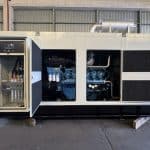
When investing in a diesel generator for sale, no step is more critical than correctly determining the required size. Sizing your unit accurately ensures you have sufficient backup power South Africa during load shedding while keeping your running costs at an optimised level. An incorrectly sized generator—whether too small or drastically too large—will be inefficient, costly, and can even damage your equipment.
Here is the definitive diesel generator sizing guide, based on industry best practise and local South African conditions, to help you understand what size generator you truly need.
The Essential First Step – The Load Test
It is extremely difficult to make use of online power calculators to determine your precise requirement as appliances vary widely in their start-up and normal running load.
Get a Load Test from a Qualified Electrician
The most accurate and reliable method to determine your exact power requirement is to have a qualified electrician conduct a load test at your premises. This test measures the real-time electrical demand of your essential and non-essential circuits, providing a verifiable figure in Amperes (Amps) and Kilowatts (kW).
Determining Your Essential Load List
Before the test, you must clearly determine what needs to run during an outage. Do you need to run everything in your home or business, or just the essentials?
-
Essential Loads: Lights, security systems, gate motors, Wi-Fi routers, fridges, and IT equipment. These are typically the priority for backup power South Africa.
-
Non-Essential Loads: Geysers, air conditioners, electric stoves, pool pumps, and tumble dryers. These are high-demand items often excluded to keep the generator size—and consequently, the diesel generator prices and running costs—down.
Understanding Your Load: Running vs. Surge Power Generator Sizing Guide
Your generator must be sized not just for continuous running power, but for the sudden, brief power spikes created by motors.
The Motor Multiplier: Why Surge Power Matters
All electrical equipment has two ratings:
-
Running Wattage (or kW): The power needed to keep the appliance operating.
-
Starting/Surge Wattage (or kVA): The brief, high load required to start electric motors (e.g., in pumps, air conditioners, or compressors) from a standstill.
Electric motors can draw up to three to seven times (3x to 7x) their running power at start-up. If your generator cannot handle the surge of the largest motor you intend to run, the system will trip or overload, which can damage the generator and your equipment.
The Sizing Formula (Simplified):
Total Generator kVA Capacity = (Total Running kW of All Appliances) + (Starting kW of the Single Largest Motor) + Safety Margin (20%)
Phase Requirement: Single-Phase vs. Three-Phase
Before any calculation can be finalized, you must identify your existing power supply phase:
-
Single-Phase (220-240V): Most common for residential homes and small commercial properties in South Africa.
-
Three-Phase (380-400V): Mandatory for businesses with large motors, heavy machinery, and industrial systems (e.g., factory floors, large HVAC units). Generator King supplies both single-phase and three-phase SDEC and Baudouin units.
The South African Sizing Factor: De-rating for Altitude and Climate
Failure to account for environmental factors specific to South Africa will result in an undersized generator that fails to deliver its rated capacity when you need it most.
De-rating for Altitude (Elevation)
Due to the thin air at higher elevations, a generator’s engine must reduce fuel delivery because less oxygen is available for combustion.
-
The Rule: For every 100 metres above sea-level (starting typically above 1,000m), the output of your generator will de-rate (decrease) by approximately 1% of its capacity.
-
Local Impact: Sites in Gauteng, which is situated over 1,500m above sea level, are significantly affected. If you purchase a 100kVA unit at sea level but utilise it in Johannesburg, its actual available power may be closer to 95kVA or less.
Environmental Conditions: Temperature
High ambient temperatures (often exceeding 35°C in the summer) reduce air density further and strain the cooling system.
-
The Factor: High temperatures can reduce the generator’s output, compounding the effect of altitude. Industrial-grade units often require tropical-rated cooling systems to ensure performance remains reliable under real-world conditions.
Your Generator King specialist will factor these de-rating percentages into your final size recommendation.
Optimal Running Conditions for Longevity
Sizing is also about the generator’s health and efficiency over time.
The 70-80% Load Rule
-
Optimal Performance: Your generator should run at an average of 70% to 80% of its capacity for the best fuel consumption and longevity of your unit. Running within this range keeps the engine warm, maintains oil pressure, and provides a buffer for minor load spikes.
-
Minimum Load: Running the generator at less than 40% load for extended periods can cause damage known as “wet stacking” (unburnt fuel and oil contaminating the exhaust system), which requires costly maintenance and can reduce the unit’s lifespan.
-
Overloading: You must never overload the unit beyond its rated maximum capacity, as this will result in immediate shutdown, system damage, and potential electrical failure.
Conclusion: Secure Your Investment with Expert Sizing
Correct sizing requires organising your load list, understanding your phase requirement, and applying local de-rating factors. It is too complex to leave to guesswork.
-
Final Steps: After consulting this guide, get an electrician to do a load test for you. Then, bring the data to Generator King. We specialise in matching the right FAW, SDEC or Baudouin unit to your exact site requirements.
-
After-Sales Peace of Mind: Ensure your supplier offers backup and support should you need it, and that they have genuine parts available locally. Generator King guarantees both.
Do not buy a generator until you know the precise size you need. Contact Generator King today for an expert consultation on your sizing requirements and to get a quote on the genset installation.